B — AI & Mechanical Engineering
Where Physics
Meets AI
Computer vision, speaker recognition, graph neural networks for mechanical simulation, and advanced predictive algorithms.
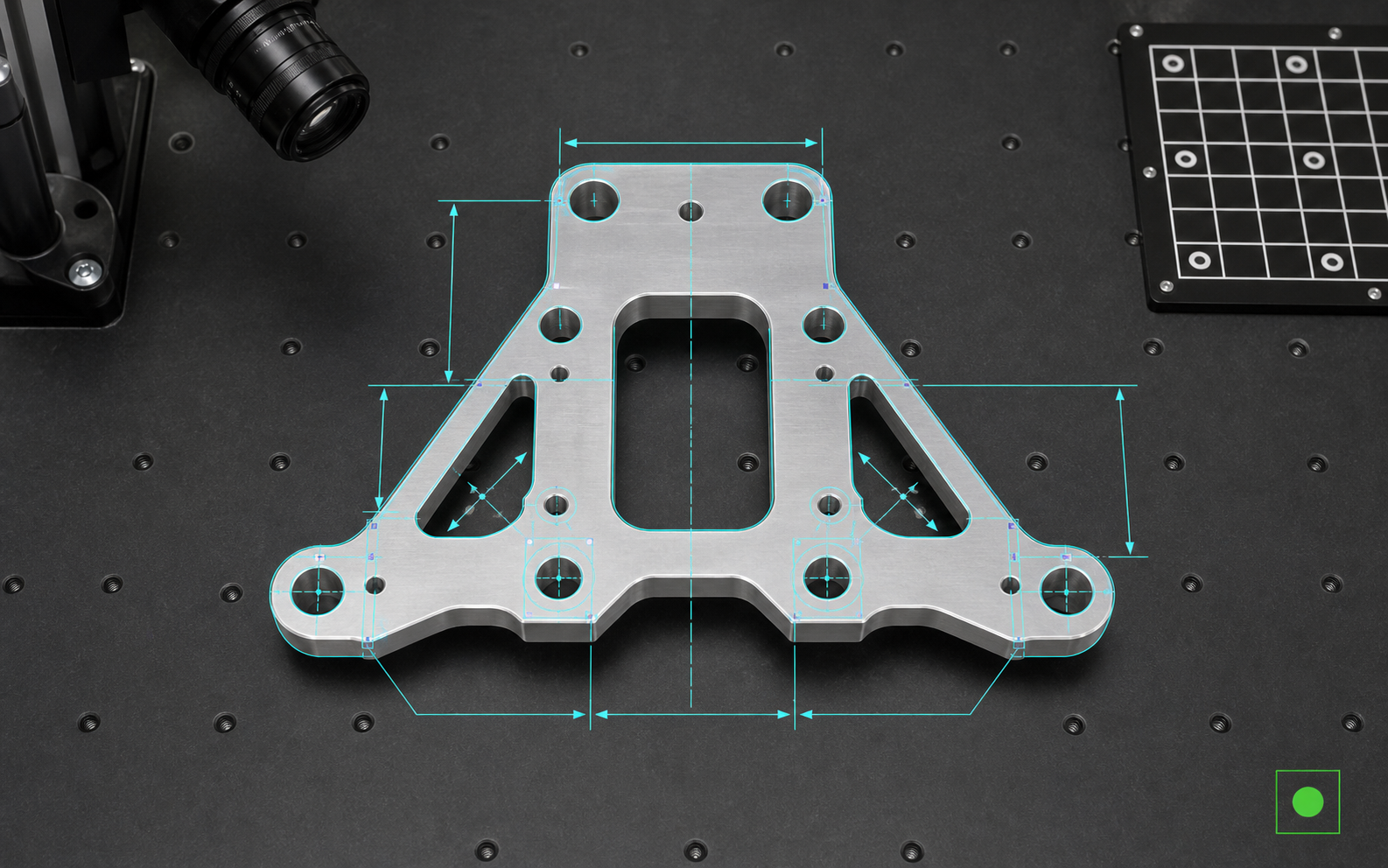 B.01.01 — OpenCV / Metrology
Vision-Based Dimensional Inspection
A calibrated camera system that measures manufactured parts and checks critical dimensions against engineering tolerances in real time.
Manual caliper checks are slow and difficult to scale. The pipeline corrects lens distortion, detects the part contour and reference points, converts pixels to millimetres, and produces a clear pass/fail overlay for each inspected dimension.
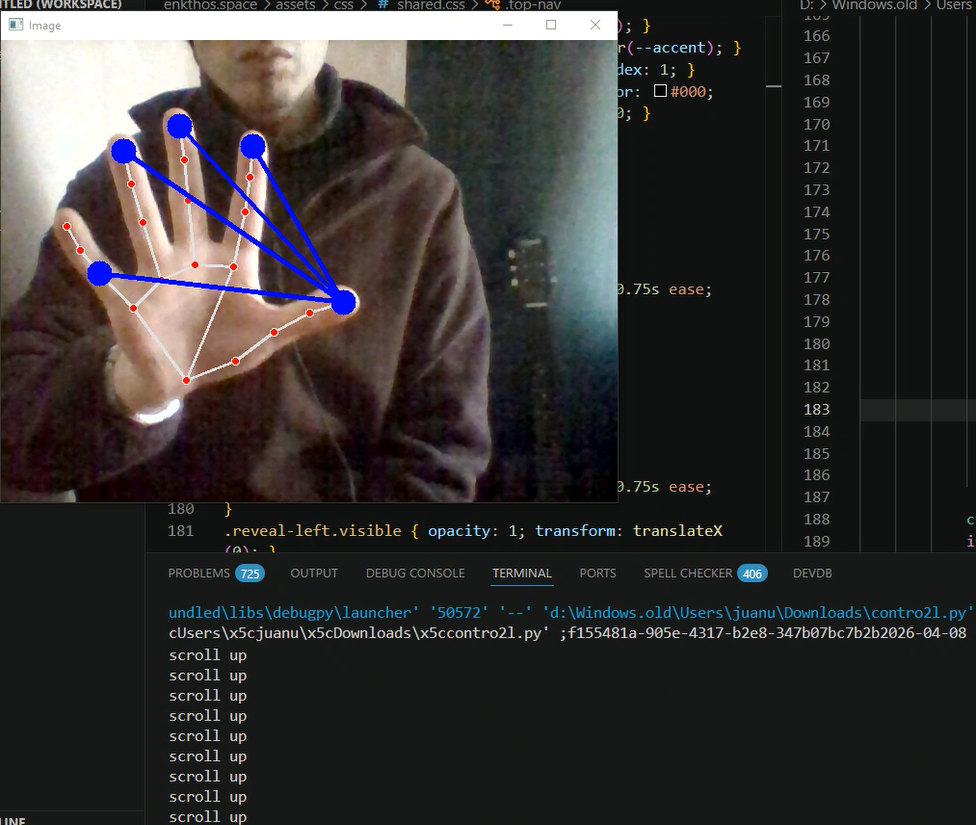 B.01 — Python / OpenCV
Hand Gesture Control
A lightweight, real-time hand gesture recognition app built with MediaPipe and OpenCV. Scroll pages, play/pause videos, and interact with your PC using natural hand movements.
Current Features
- Scroll Up / Scroll Down
- Play / Pause media with pinky gesture
- Global hotkey activation
- Real-time visualization with landmarks
View on GitHub →
Sometimes while reading or consuming content, you want to scroll and control the screen freely while reclined or leaning back — without constantly reaching for your mouse or keyboard.
Beyond everyday use, this technology shines in industrial and mechanical engineering applications. It enables truly hands-free control in environments where operators must maintain a safe distance from machinery, work in hazardous conditions, or need both hands occupied with tools and equipment.
From controlling robotic arms and CNC machines to inspecting complex 3D mechanical designs, gesture-based interaction allows engineers and technicians to operate systems naturally and safely without touching contaminated controls or interrupting their workflow.
 B.02 — Signal Processing
AI Speaker Recognition
Speaker identification system using signal processing and machine learning — extracts voice fingerprints from audio for authentication.
Needed a lightweight, offline-capable voice ID system. MFCC feature extraction + an SVM classifier achieved >92% accuracy on a test dataset without cloud dependency.
 B.03 — PyTorch / GNN
GNN for Mechanical Systems
Graph Neural Network applied to mechanical engineering — modelling component relationships as a graph to predict structural behaviour and failure.
FEM simulations were computationally expensive. The GNN learned to approximate simulation outputs in milliseconds, enabling real-time design feedback.
 B.04 — ML Algorithms
GMM & Neural Net Tests
Research experiments with Gaussian Mixture Models and neural network architectures for predicting mechanical material behaviour under variable conditions.
Benchmarked GMM, MLP, and LSTM approaches against standard regression for stress-strain curve prediction. GMMs outperformed in low-data regimes.